

Last updated: 31 August 2026. The eTA (Subclass 601) allows up to 3 months for tourism and strictly prohibits paid employment under Condition 8101. The eTA is a digital travel authority for short visits, while work visas provide legal work rights, multi-year stays, and permanent residency pathways.
eTA Australia vs work visa key difference: The eTA (Subclass 601) allows up to 3 months stay for tourism or short business visits and prohibits paid employment. Work visas like Subclass 482 (employer-sponsored), 189/190 (skilled independent/nominated), partner, or business visas permit legal employment, allow stays from 2 to 4+ years, and provide pathways to permanent residency. If you plan to work or stay beyond 3 months, an eTA alone is not enough.
What Is the eTA (Subclass 601) and Can You Work on It?
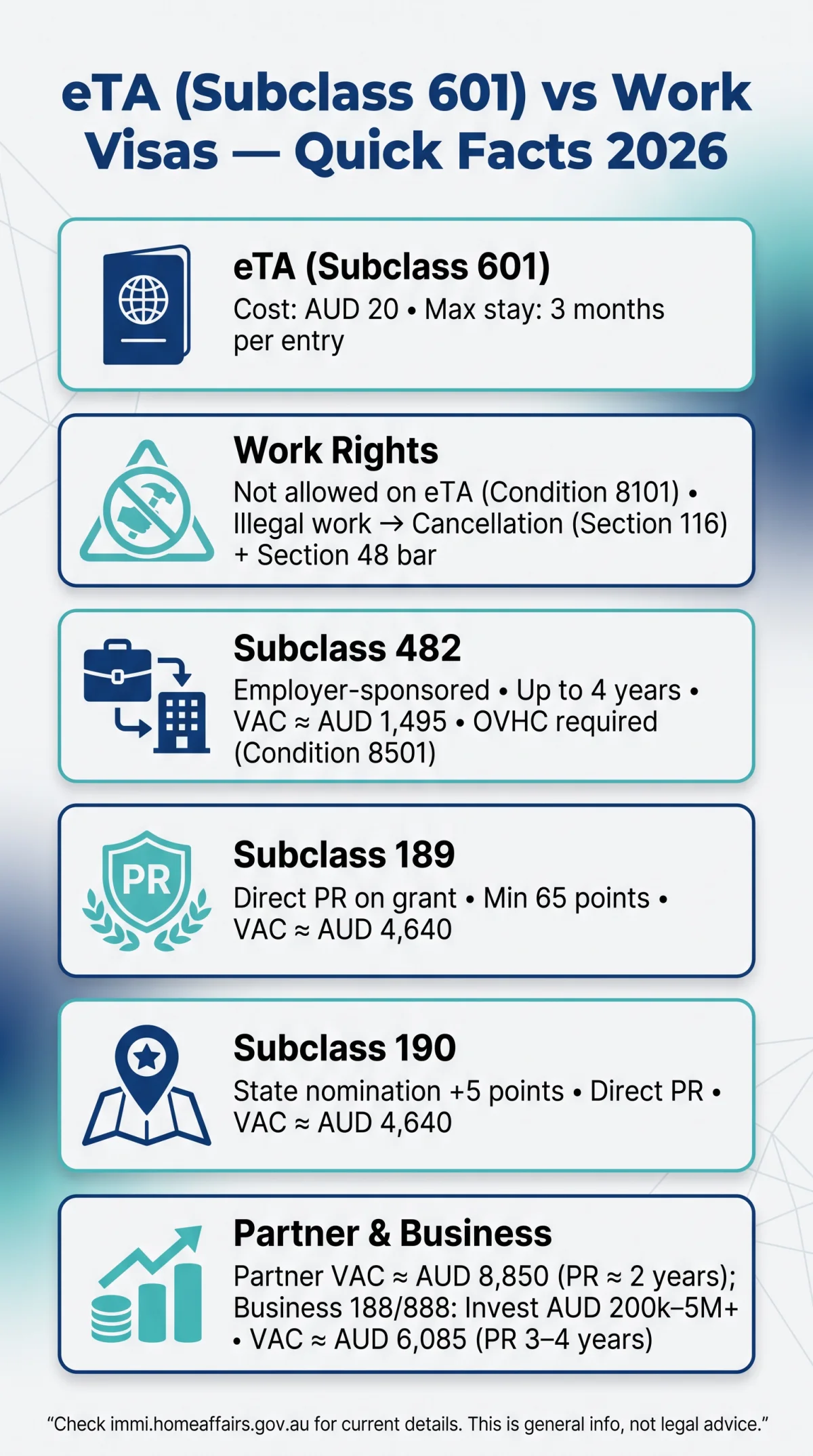
The eTA Australia (Electronic Travel Authority, Subclass 601) is a digital travel authorization for tourism and short business visits, strictly prohibiting paid work. It costs ~AUD 20, is valid for up to 12 months, and allows a maximum stay of 3 months per entry. Permitted activities include attending conferences and conducting negotiations, but local employment of any kind is barred under Condition 8101. Working illegally triggers visa cancellation under Section 116, deportation, and a Section 48 bar on future onshore applications.
For any paid employment in Australia, a substantive work visa such as Subclass 482 is required. Visa details are available on the Department of Home Affairs immigration and citizenship website at immi.homeaffairs.gov.au. UK-based applicants can also contact the Australian High Commission, Australia House, Strand, London, WC2B 4LA, United Kingdom; phone: +44 (0) 20 7379 4334.
Long-Term Work and Skilled Visas: Subclass 482, 189, and 190
The eTA Australia limits your stay to three months and prohibits all paid employment. The three visas below each permit legal work and offer multi-year stays, but require employer sponsorship or a points-based application.

- Subclass 482 (Temporary Skill Shortage): Employer sponsorship is mandatory. Your nominated occupation must appear on the MLTSSL or STSOL lists. Maximum stay is up to 4 years, with a VAC of ~AUD 1,495 for the primary applicant.
- Subclass 189 (Skilled Independent): Grants direct permanent residency from the date of grant. Requires a minimum of 65 points under the points-based system and an occupation on the MLTSSL. VAC is ~AUD 4,640.
- Subclass 190 (Skilled Nominated): State or territory nomination adds 5 points to the 65-point minimum. Also grants direct permanent residency from the date of grant. Unlike the eTA Australia, each of these visas provides a pathway to settlement.
Partner and Business Visas for Extended Stays
The eTA Australia offers no settlement pathway based on relationships or investments. Partner visas (Subclass 820/801 onshore or 309/100 offshore) require proof of a de facto relationship of 12+ months or marriage. The application cost is ~AUD 8,850, leading to permanent residency in approximately 2 years.
The Business Innovation and Investment Visa (Subclass 188/888) requires a qualifying investment from AUD 200,000 to 5M+ depending on the stream. With a Visa Application Charge of ~AUD 6,085, holders can achieve permanent residency in 3 to 4 years. Unlike the eTA Australia, these visa categories facilitate permanent settlement.
eTA vs Other Australian Visas: Side-by-Side Comparison
A direct comparison reveals stark differences in work rights, stay duration, costs, and PR pathways. The eTA Australia costs only AUD 20, whereas work visas demand significantly higher financial commitments.
| Visa | Subclass | Work Rights | Max Stay | VAC Cost & Extras | PR Pathway |
|---|---|---|---|---|---|
| eTA Australia | 601 | None | 3 months | AUD 20 | No |
| Work Visa | 482 | Yes | 4 years | AUD 1,495 + OVHC (Condition 8501) | Yes (via 186) |
| Skilled Ind. | 189 | Yes | Permanent | AUD 4,640 + skills assessment (AUD 500-1,000) | Direct PR |
| Skilled Nom. | 190 | Yes | Permanent | AUD 4,640 + skills assessment | Direct PR |
| Partner | 820/801 | Yes | Permanent | AUD 8,850 | Yes (2 years) |
| Business | 188/888 | Yes | 4+ years | AUD 6,085 | Yes (3-4 years) |
Switching from an eTA to a Work Visa Onshore
Switching from an eTA to a work visa inside Australia is possible via a Bridging Visa A, unless Condition 8503 applies. The eTA Australia cannot be directly converted, but you can lodge a new substantive visa application while onshore.
Enter on eTA
Arrive using the eTA Australia (Subclass 601), valid for up to 3 months.
Receive job offer
Secure employment from an Australian employer willing to sponsor your Subclass 482 visa.
Lodge onshore application
Apply for the 482, 189, or 190 visa via your ImmiAccount.
Bridging Visa A granted
If your current visa expires before a decision, a Bridging Visa A is granted automatically, letting you stay lawfully.
For example, a UK passport holder who arrives on an eTA and receives a Sydney-based job offer can lodge a Subclass 482 application onshore via their ImmiAccount; a Bridging Visa A would allow them to stay lawfully during processing. Check your grant notice for Condition 8503 (No Further Stay), which blocks onshore applications entirely. This article is for informational purposes only and does not constitute legal advice. For professional guidance, consult a registered migration agent listed on the Migration Agents Registration Authority (MARA) register.
Pathways to Permanent Residency and Decision Summary
The eTA Australia offers zero pathway to permanent residency, while work, skilled, partner, and business visas each lead to permanent settlement through distinct timelines.
The eTA Australia cannot be extended or converted into any PR visa. By contrast, Subclass 189 and 190 grant permanent residency directly from the date of visa grant. The Subclass 482 work visa leads to PR via the Employer Nomination Scheme (Subclass 186 TRT) after 2 to 4 years of sponsorship. Partner visa holders transition from Subclass 820 to 801 after approximately 2 years. Business Innovation and Investment visa holders move from Subclass 188 to 888 after 3 to 4 years.
Choose the eTA Australia only for stays under 3 months with no employment. If you intend to work or remain longer, apply for Subclass 482, 189, 190, a partner visa, or a business visa before travelling. Visa costs, occupation lists, and processing times change frequently; always verify current details on the Department of Home Affairs website before applying.
FAQ: eTA Australia vs Work Visa
What is the difference between an eTA and a visa for Australia?
The eTA is a visa (Subclass 601), a digital travel authority linked to your passport. It allows stays of up to 3 months per entry for tourism or short business visits. Unlike work visas, it does not permit employment.
Can I legally work in Australia as a UK citizen on an eTA?
No. UK citizens can use an eTA or eVisitor (Subclass 651), but both prohibit paid employment under Condition 8101. To work legally, you must apply for a Subclass 482, 189, 190, or Working Holiday Visa (Subclass 417).
How many points do I need for a skilled visa (189 or 190)?
You need a minimum of 65 points for both Subclass 189 and 190. Points are awarded for age, English proficiency, skilled work experience, and qualifications. Subclass 190 requires an additional 5 points from a state or territory nomination.
Is it difficult to get a work visa for Australia?
The Subclass 482 requires employer sponsorship and a nominated occupation. The Subclass 189 requires a competitive points score and an occupation on the MLTSSL. Both are achievable with proper preparation.
What happens if I work illegally on an eTA?
Working on an eTA triggers visa cancellation under Section 116, deportation, and a Section 48 bar on future onshore applications. The eTA strictly prohibits paid work under Condition 8101.
Is my occupation eligible for an Australian work visa?
Eligibility depends on occupation lists: Subclass 189 uses the MLTSSL, Subclass 482 uses MLTSSL and STSOL, and Subclass 190 has state-specific additions. A skills assessment from a designated authority is required.
Do I need health insurance for an Australian work visa?
Subclass 482 holders must maintain Overseas Visitor Health Cover (OVHC) under Condition 8501. eTA holders have no mandatory requirement, though reciprocal health care agreements exist for countries like the UK and New Zealand.
Can I enter Australia on an eTA and then apply for permanent residency?
You cannot apply for permanent residency directly from an eTA. You must transition to a qualifying visa like Subclass 482, 189, 190, partner, or business visa first. Some can be lodged onshore unless Condition 8503 applies.