
Published: 31 August 2026. Fees and conditions reflect 2026 figures sourced externally from the Department of Home Affairs. This article provides general information only and does not constitute migration advice; consult a registered migration agent for personalised guidance.
An Electronic Travel Authority (eTA, Subclass 601) costs ~AUD 20 and permits 90-day tourism stays, but strictly prohibits work and limits study to 3 months. For longer study or employment, travellers must compare the eTA Australia vs student visa (Subclass 500) and working holiday visa (Subclass 417/462) pathways. This guide covers work rights, study limitations, duration, costs, health insurance, and onshore visa-switching rules.
An Electronic Travel Authority (eTA) allows stays of up to 90 days for tourism only – you cannot work, and study is limited to short courses under 3 months. A Subclass 500 student visa enables full-time study for up to 5 years, includes limited work rights (48 hours per fortnight), and requires Overseas Student Health Cover (OSHC). A Working Holiday Visa (Subclass 417/462) allows unrestricted work for up to 12 months but limits study to 4 months. Choose the visa that matches your primary purpose: eTA for short visits, Subclass 500 for studying, or 417/462 for working and travelling.
eTA vs Student Visa vs Working Holiday Visa: At a Glance
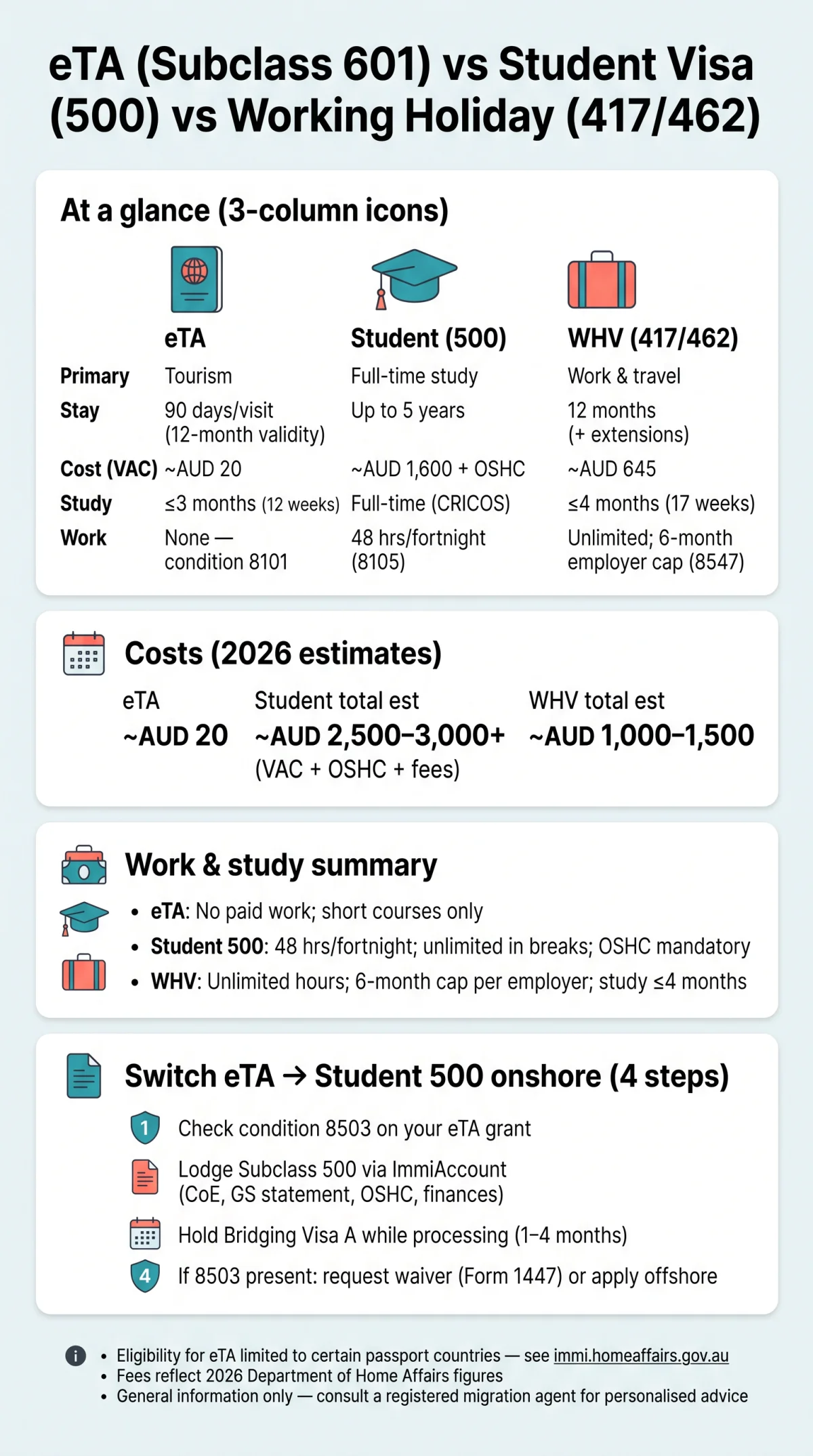
The eTA costs ~AUD 20 for 90-day tourism stays, while Subclass 500 (~AUD 1,600) and WHV 417/462 (~AUD 645) unlock study and work rights. In the eTA Australia vs student visa comparison, the eTA restricts study to 3 months and prohibits all work, whereas Subclass 500 and WHV 417/462 grant broader rights for non-tourist purposes.
| Attribute | eTA Australia (Subclass 601) | Student Visa (Subclass 500) | WHV (Subclass 417/462) |
|---|---|---|---|
| Primary purpose | Tourism | Full-time study | Work & travel |
| Study rights | ≤3 months (12 weeks) | Unlimited (full-time) | ≤4 months (17 weeks) |
| Work rights | None (8101) | 48 hrs/fortnight; unlimited breaks | Unlimited; 6-month cap (8547) |
| Duration | 90 days/visit; 12-month validity | Up to 5 years | 12 months + extensions |
| Application fee | ~AUD 20 | ~AUD 1,600 | ~AUD 645 |
| Processing time | Minutes (up to 72 hrs) | 1-4 months | Days-weeks |
| Age limit | None | None | 18-30 (417); up to 35 (462) |
| Health insurance | None required | OSHC mandatory (~AUD 600-900/yr) | Private/RHCA recommended |
| Key conditions | 8101 | 8202, 8105 | 8547 |
Fees reflect 2026 Base Visa Application Charges (VAC) from the Department of Home Affairs and are subject to change.
What You Can Actually Do on an eTA in Australia
The eTA (Subclass 601) prohibits all paid employment (condition 8101) and restricts study to incidental courses of 3 months or fewer.
The Electronic Travel Authority permits a maximum stay of 90 days per visit within a 12-month validity period and imposes no age restriction. Study is limited to 3 months (12 weeks) of incidental short courses, such as language classes or brief training programmes – full-time enrolment in CRICOS-registered courses is not allowed. Work is absolutely prohibited under condition 8101 (No Work), including unpaid volunteer positions that would normally be paid. The eTA application is fully automated, typically taking minutes, with a fee of approximately AUD 20 and no mandatory health insurance requirement. Eligibility is limited to passport holders from designated countries, including the United States, Canada, United Kingdom, Japan, South Korea, Singapore, Hong Kong (SAR), Malaysia, Brunei, and selected European nations (full list at immi.homeaffairs.gov.au).
Subclass 500 Student Visa – Full Breakdown
Unlike the eTA, which limits study to 3 months, the Subclass 500 enables full-time study for up to 5 years at a cost of ~AUD 1,600.
The Subclass 500 student visa requires a Confirmation of Enrolment (CoE) from a CRICOS-registered institution and covers sectors including higher education, VET, ELICOS, school, and postgraduate research. Applicants must pass the Genuine Student (GS) assessment, which evaluates academic intentions, ties to the home country, and career alignment – replacing the former Genuine Temporary Entrant (GTE) requirement. The GS process contrasts sharply with the eTA’s automated minutes-long approval.
Key Requirements and Conditions
- Duration: Up to 5 years, aligned with enrolment plus a buffer
- Work rights: 48 hours per fortnight during study terms; unlimited during scheduled breaks (condition 8105)
- Health insurance: Mandatory OSHC for the full enrolment period (~AUD 600-900/year)
- Evidence of financial capacity: Tuition fees plus living costs of AUD 21,041/year plus travel costs
- Processing time: 1-4 months (varies by sector and country of origin)
- Condition 8202: Must maintain enrolment and satisfactory academic progress
For travellers who initially entered Australia on an eTA and wish to study full-time, the Subclass 500 is the appropriate pathway.
Working Holiday Visa Subclass 417/462 – What It Offers
While the eTA prohibits all work, the Working Holiday Visa (Subclass 417/462) allows full-time employment for 12 months at ~AUD 645.
The WHV comes in two subtypes: Subclass 417 (Working Holiday) and Subclass 462 (Work and Holiday), differing in eligible countries and age limits. Subclass 417 is available to applicants aged 18-30, while Subclass 462 extends to 35 in selected countries. Work rights are unlimited in hours, but condition 8547 caps employment with a single employer at 6 months. Study is permitted for up to 4 months (17 weeks) – one month longer than the eTA’s 3-month limit. The visa is valid for 12 months, with extensions available for a second year (3 months of specified work in regional Australia) and a third year (6 months of specified work). Processing takes days to several weeks, and no OSHC is required, though private insurance or Reciprocal Healthcare Agreements are recommended.
For travellers who want to work and travel but started on an eTA, switching to a WHV requires leaving Australia and applying offshore.
Work Rights Compared – eTA vs Subclass 500 vs Subclass 417/462
The eTA allows zero work hours, Subclass 500 permits 48 hours per fortnight, and Subclass 417/462 permits unlimited hours with a 6-month employer cap.
| Visa | Work Allowed | Hour Limit | Employer Limit | Key Condition |
|---|---|---|---|---|
| eTA (601) | No | 0 hours | N/A | 8101 |
| Student (500) | Yes (capped) | 48 hrs/fortnight (term); unlimited (breaks) | None | 8105 |
| WHV 417/462 | Yes (full-time) | Unlimited | 6 months per employer | 8547 |
The eTA restricts study to 3 months, while the WHV permits 4 months – a one-month advantage. Subclass 500 research assistant (casual) work is permitted under the fortnightly cap. Subclass 417/462 agricultural or aged care work may qualify holders for visa extensions.
Can You Switch from eTA to a Student Visa Onshore?
Switching from an eTA to Subclass 500 onshore is possible only if condition 8503 (No Further Stay) has not been applied to the eTA grant.
Check condition 8503
Review your eTA grant letter for No Further Stay. If absent, proceed onshore.
Lodge Subclass 500 application
Apply via the ImmiAccount portal.
Submit required documents
Provide CoE, Genuine Student statement, OSHC, and financial capacity evidence.
Hold Bridging Visa A
Remain in Australia on BVA while the student visa is processed (1-4 months).
If condition 8503 is present, you may request a waiver via Form 1447 (processing time varies, often 2-4 weeks, not guaranteed; compelling circumstances such as illness or family bereavement may be required) or depart Australia and apply offshore. The Department of Home Affairs assesses each case individually, considering factors such as the applicant’s compliance history and the purpose of stay.
Case study: A traveller arriving on an eTA wanted to study English for 6 months. Discovering the 3-month eTA limit, she had to apply offshore for Subclass 500, costing AUD 1,600 + OSHC. Applying pre-departure would have avoided the 8503 risk.
Cost Comparison – eTA vs Student Visa vs Working Holiday Visa (2026)
In 2026, the eTA costs ~AUD 20, Subclass 500 costs ~AUD 1,600 plus mandatory OSHC, and the WHV 417/462 costs ~AUD 645.
| Cost Element | eTA | Student Visa (Subclass 500) | WHV (417/462) |
|---|---|---|---|
| Application fee (VAC) | ~AUD 20 | ~AUD 1,600 | ~AUD 645 |
| Health insurance | None required | OSHC ~AUD 600-900/year | Private ~AUD 300-600/year |
| Biometrics (if applicable) | N/A | AUD ~20-50 (select countries) | AUD ~20-50 (select countries) |
| Medical examination | Not typically required | May be required (~AUD 300-500) | May be required (~AUD 300-500) |
| Police check | Not required | May be required | May be required |
| Total estimated cost | ~AUD 20 | ~AUD 2,500-3,000+ | ~AUD 1,000-1,500 |
Subclass 500 mandates Overseas Student Health Cover from an accredited provider (Medibank, Allianz, OSHC Worldcare, Bupa, NIB) for the full enrolment period. The eTA and WHV rely on Reciprocal Healthcare Agreements or private insurance. Fee figures are sourced externally from the Department of Home Affairs and are subject to change.
Health Insurance – What You Need for Each Visa
Subclass 500 mandates OSHC for the full enrolment period, while eTA and WHV holders have no compulsory health insurance requirement.
Subclass 500 requires Overseas Student Health Cover (OSHC) from an accredited provider – Medibank, Allianz, OSHC Worldcare, Bupa, or NIB – for the entire study period, at approximately AUD 600-900/year. The eTA and WHV have no mandatory insurance, but Australia holds Reciprocal Healthcare Agreements (RHCA) with 10 countries: UK, New Zealand, Belgium, Finland, Ireland, Italy, Malta, Norway, Slovenia, and Sweden (list subject to change). Travellers from non-RHCA countries should carry private travel insurance, as hospital treatment in Australia can cost AUD 1,500+/day without coverage. WHV holders are additionally advised to obtain medi-evac insurance.
FAQ: eTA vs Student Visa and Working Holiday Visa
How long can I stay in Australia on an eTA vs a student visa vs a working holiday visa?
The eTA allows 90 days per visit with 12-month validity. Subclass 500 permits stays up to 5 years. The WHV (Subclass 417/462) grants 12 months, with extensions for a second year (3 months specified regional work) and a third year (6 months specified work).
Can I study full-time in Australia on an eTA?
No. The eTA limits study to 3 months (12 weeks) of incidental courses. Full-time study at a CRICOS-registered institution requires a Subclass 500 student visa.
What is the age limit for the working holiday visa compared to eTA?
WHV 417: 18-30 years. Subclass 462: 18-30 years (up to 35 in selected countries). The eTA has no age restriction.
How much does a student visa cost compared to an eTA in 2026?
In 2026, the eTA costs ~AUD 20. The Subclass 500 student visa costs ~AUD 1,600 plus mandatory OSHC (~AUD 600-900/year).
Can I work while studying in Australia on a Subclass 500 student visa?
Yes, under condition 8105: 48 hours per fortnight during study terms, unlimited during scheduled breaks.
What documents do I need for a Subclass 500 student visa application?
A CoE from a CRICOS-registered institution, evidence of financial capacity (tuition + AUD 21,041/year living costs + travel), a Genuine Student statement, OSHC, passport, and biometrics or police checks as required.
Is it easier to get an eTA or a student visa for Australia?
The eTA is automated, processed in minutes (up to 72 hours). Subclass 500 requires a GS assessment and takes 1-4 months.
Can I change from a working holiday visa to a student visa in Australia?
Yes, onshore change is generally possible if Subclass 500 criteria are met. Condition 8503 is typically not applied to WHVs, allowing you to lodge a Subclass 500 application via ImmiAccount.
What is the Genuine Student assessment for the Australian student visa?
The GS assessment evaluates true intention to study, replacing the GTE requirement. It requires a statement of academic intentions, evidence of home-country ties, and career alignment.
Do I need health insurance for an eTA or working holiday visa in Australia?
Neither requires mandatory insurance, though RHCA with 10 countries (UK, New Zealand, Belgium, Finland, Ireland, Italy, Malta, Norway, Slovenia, Sweden) or private insurance is recommended. Subclass 500 mandates OSHC.