
Published: 10 January 2026 | Last reviewed: 31 August 2026. For current requirements, refer to the Department of Home Affairs (immi.homeaffairs.gov.au).
eTA Australia financial requirements demand proof of sufficient funds, a confirmed return or onward ticket, and adequate health insurance. The Electronic Travel Authority (Subclass 601) permits multiple entries with a maximum three-month stay per visit, remains valid up to one year (or passport validity, whichever is shorter), and is electronically linked to the applicant’s passport. Australian Border Force (ABF) officers assess bank statements and travel documents at arrival.
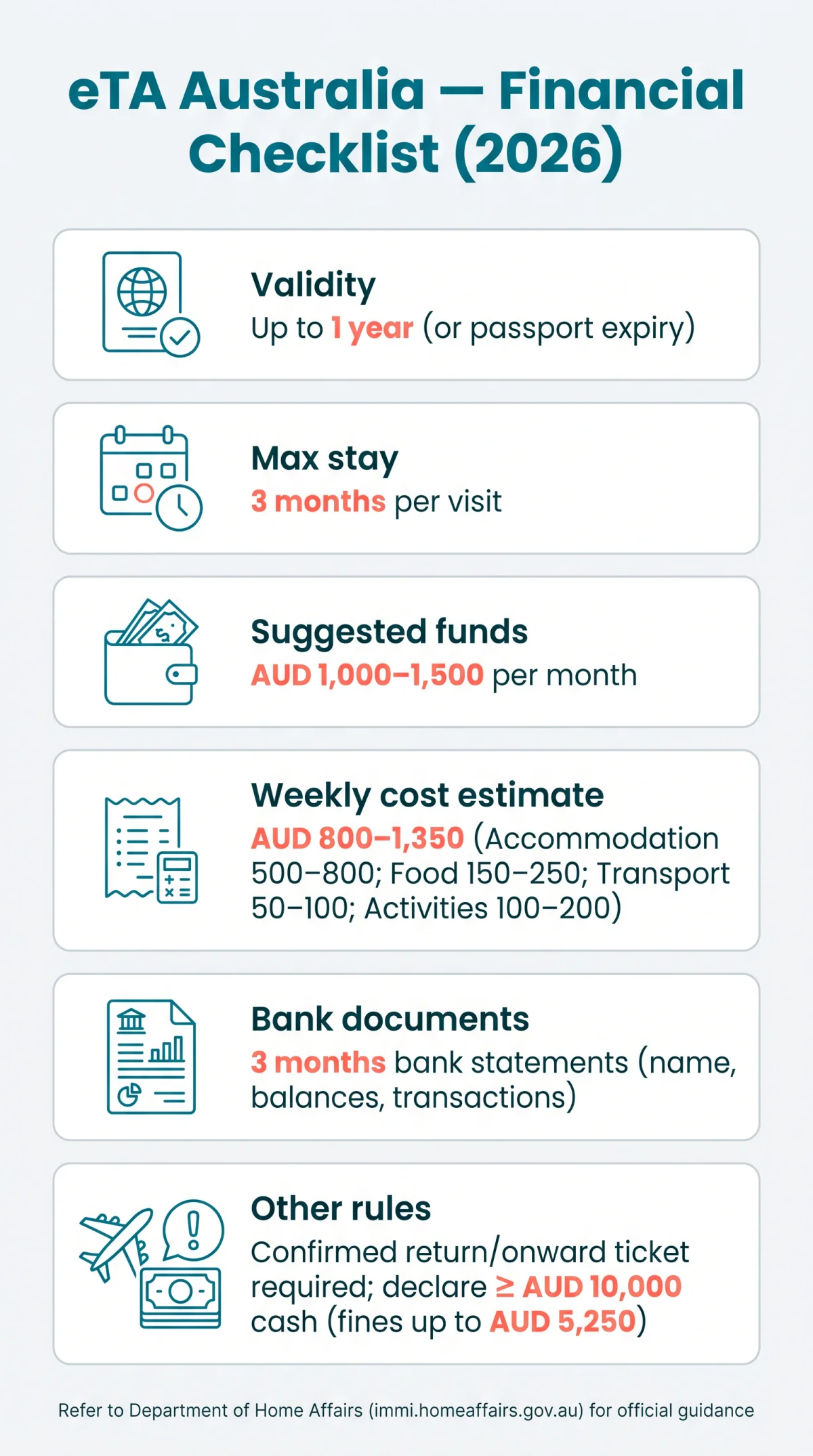
Applicants must show they can fund accommodation (~AUD 800/week), food (~AUD 200/week), transport (~AUD 100/week) and activities (~AUD 150/week) during their stay. While no fixed government threshold exists, migration agents commonly advise a practical benchmark of AUD 1,000 to 1,500 per month of intended stay.
Preparing the correct documentation, including bank statements covering the most recent three months and a confirmed departure booking, ensures compliance with ABF expectations. Travellers must also understand cash declaration rules and health insurance coverage to avoid visa cancellation under Section 116 of the Migration Act.
Proof of Funds & eTA Australia Financial Requirements
eTA Australia financial requirements do not set a fixed statutory threshold for proof of funds. Applicants must demonstrate sufficient funds to cover living costs throughout their stay. A practical minimum balance benchmark is AUD 1,000-1,500 per month of intended stay for eTA (Subclass 601) tourists, reflecting migration agent consensus rather than a published government figure.
| Expense Category | Per-Week Cost (AUD) |
|---|---|
| Accommodation | 500-800 |
| Food | 150-250 |
| Transport | 50-100 |
| Activities | 100-200 |
| Total per week | 800-1,350 |
| 12-week total | 9,600-16,200 |

eTA Australia financial requirements demand bank statements covering the most recent 3 months, issued by the bank with the applicant’s full name, transaction history and closing balance visible. Officers check for regular salary deposits every 2-4 weeks, spending aligned with declared income, and no overdraft history. Sudden large unexplained deposits right before the application are a red flag that can trigger additional scrutiny.
Statements must be bank-issued documents showing the applicant’s name, account number (partial acceptable), opening and closing balances, and a clear transaction history. Foreign currency statements are accepted; providing an AUD equivalent conversion is helpful but not mandatory.
Alternative Documents: Pay Slips & Tax Records
Bank statements are the primary evidence, but eTA Australia financial requirements also accept supplementary documents: pay slips from the last 3 months, tax returns, employment letters stating salary, credit card statements showing available limit, and investment portfolio summaries. These alternatives strengthen the application but do not replace bank statements entirely.
Return Ticket & Onward Travel Rules for eTA Holders
eTA Australia financial requirements mandate that all applicants hold a confirmed return ticket or onward travel booking before departure, as airlines such as Qantas, Emirates and Jetstar routinely verify departure evidence at check-in and may deny boarding without it.
The ‘genuine visitor’ test (Migration Regulations, Schedule 4, PIC 4013) requires proof of departure: a confirmed booking with a PNR reference number, not an unconfirmed travel itinerary. Open-jaw itineraries qualify if each segment carries a valid confirmation code. Under eTA Australia financial requirements, the genuine visitor assessment also evaluates ties to the traveller’s home country, including employment, property ownership, and family connections that indicate intent to return.
Avoiding Non-Refundable Commitments Before Visa Grant
The Australian High Commission (UK) advises travellers not to make non-refundable financial commitments before receiving visa grant confirmation. Refundable fare classes or flexible bookings protect against financial loss if the eTA is refused. eTA Australia financial requirements do not waive this risk, so applicants should confirm approval before purchasing non-refundable tickets.
Health Insurance Requirements for eTA Visitors
Overseas Visitor Health Cover (OVHC) is not a strict legal obligation under eTA Australia financial requirements, but citizens of 11 Reciprocal Health Care Agreement (RHCA) countries receive limited Medicare coverage for emergency treatment and public hospital care. eTA Australia financial requirements strongly recommend securing OVHC (AUD 30-80/month depending on provider and age) to avoid out-of-pocket costs.
Countries with Reciprocal Health Care Agreements
Eligible RHCA nations include the UK, Ireland, Italy, Belgium, New Zealand, Finland, Norway, Sweden, Slovenia, Malta, and the Netherlands. Australian ambulance costs alone can exceed AUD 1,000, and RHCA does not cover GP visits, dental, or ambulance services. Travellers from non-RHCA countries should obtain OVHC before departure.
| Medical Service | Covered by RHCA? |
|---|---|
| Emergency treatment | Yes |
| Public hospital care | Yes |
| GP visits | No |
| Dental and ambulance | No |
Border Scrutiny & eTA Australia Financial Requirements
Travellers carrying AUD 10,000 or more in cash must declare it on arrival, and failure to prove eTA Australia financial requirements at the border can lead to visa cancellation under Section 116 of the Migration Act.
Under the Anti-Money Laundering and Counter-Terrorism Financing (AML/CTF) Act, passengers entering Australia must report cash holdings of AUD 10,000 or its foreign equivalent via the Incoming Passenger Card or Digital Passenger Declaration. Penalties for non-declaration include fines up to AUD 5,250 and immediate seizure of the funds.
Australian Border Force (ABF) officers actively verify eTA Australia financial requirements upon landing. If funds appear insufficient, ABF may request alternative evidence (e.g., mobile banking screenshots). Consequences include refused entry, removal at the traveller’s expense, and potential re-entry ban risk. Keep a printed bank statement or phone screenshot accessible to ensure swift compliance.
Featured Snippet: eTA Australia Financial Requirements
eTA Australia financial requirements include demonstrating sufficient funds to cover your stay (typically AUD 1,000-1,500/month, though no fixed threshold exists), providing recent 3-month bank statements, holding a confirmed return or onward ticket, and, while not mandatory, obtaining health insurance. ABF officers assess financial capacity at the border and may deny entry if funds appear insufficient. These eTA Australia financial requirements apply to all Subclass 601 holders regardless of nationality.
FAQ: eTA Australia Financial Requirements
How much bank balance do I need for an eTA Australia application?
No fixed threshold exists. Migration agents advise AUD 1,000-1,500 per month of intended stay. ABF assesses if your balance covers living costs for the visit.
Is a return ticket mandatory before boarding my flight to Australia?
Yes. Airlines deny boarding without a confirmed return or onward ticket. ABF may also request departure evidence at arrival.
What bank statements are accepted for eTA proof of funds?
Bank-issued statements covering the most recent three months, showing your full name, account number, opening and closing balances, and transaction history. Red flags include sudden large deposits or overdraft history.
Do I need health insurance for eTA Australia?
OVHC is not legally mandatory. Citizens of 11 RHCA countries receive limited Medicare coverage. Since ambulance costs can exceed AUD 1,000, purchasing OVHC (AUD 30-80/month) is strongly recommended.
How far in advance should I apply for my eTA?
The Australian High Commission advises against non-refundable financial commitments before visa grant confirmation. Apply early enough to receive approval before booking flights.
Can I use a friend’s or family member’s bank statement as proof of funds?
If staying with family or friends, an Australian resident can provide a sponsor guarantee letter and their own financial evidence. You should still demonstrate your own financial self-sufficiency to border officers.
Do I need to declare cash at the Australian border?
Yes. Under the AML/CTF Act, travellers carrying AUD 10,000 or more in cash or foreign equivalent must declare it on the Incoming Passenger Card. Penalties include fines up to AUD 5,250 and cash seizure.
What documents should I prepare for my eTA financial assessment?
Bank-issued statements covering the most recent three months, showing your full name and transaction history. Alternatives include pay slips, tax returns, employment letters, credit card statements, and property deeds.
Is a 3-month bank statement enough for eTA?
Yes. Statements covering the most recent three months are the standard expectation. Home Affairs expects this timeframe to demonstrate recency and consistent income patterns.
Can I submit bank statements in my local currency?
Yes. Foreign currency bank statements are accepted. Providing an AUD equivalent conversion is helpful but not mandatory to meet the AUD 1,000-1,500 per month benchmark.