

If your eTA Australia rejected status appears, you can reapply immediately or apply for an alternative visa such as the Visitor visa (Subclass 600). Most refusals carry no statutory waiting period. Address the denial reason, gather supporting documents, and submit a new application via the Department of Home Affairs portal. A refusal becomes a permanent record on your immigration history that must be declared on future visa applications to Australia and other countries like the US, UK, Canada, and New Zealand.
Understanding Why Your Australian eTA Was Rejected
- Criminal convictions: Failing the character test under Section 501 of the Migration Act triggers refusal. Obtain police clearances beforehand to mitigate this.
- Incorrect data: Passport number mismatches cause denial. Double-check all biographical data against your passport.
- Previous overstay: Prior breaches flag you as a risk. Provide evidence of strong ties to your home country.
- False information: False documents lead to refused entry and a 3-year ban under PIC 4020. Submit only authentic records.
- Outstanding debts: Unpaid debts to the Australian Government block approval. Settle all accounts before applying.
- Health grounds: Untreated communicable diseases fail the health requirement. Complete required medical examinations beforehand.
- Security concerns: Flagged applicants face immediate rejection.
- Ineligible passport: The eTA (Subclass 601) requires an eligible passport. Verify your nationality appears on the approved list.
What Happens to Your Immigration Record After an eTA Refusal
Refusals are permanently recorded on the Department of Home Affairs database and must be declared on future visa applications to Australia, the US, UK, Canada, and New Zealand.
| Country | Requirement to Declare Australian Refusal | Consequences of Non-Declaration |
|---|---|---|
| Australia | Mandatory on all future applications | Automatic refusal and potential 3-year ban under PIC 4020 |
| United States | Required for ESTA/VWP applications | ESTA revocation and mandatory visa interview |
| United Kingdom | Required for ETA declarations | ETA denial and future travel restrictions |
| Canada | Required for eTA declarations | eTA denial and border entry delays |
| New Zealand | Required for NZeTA declarations | NZeTA denial and character concerns |
A refusal differs from a cancellation, which occurs when a granted visa is revoked due to breach of conditions. Under Public Interest Criterion 4020, providing false documentation triggers a 3-year ban on new applications. The eTA Australia rejection process exposes applicants to Five Eyes intelligence sharing, meaning partner nations access this immigration record during background checks.
Complete Step-by-Step Guide – From Refusal to Reapplication
Receive the refusal notice
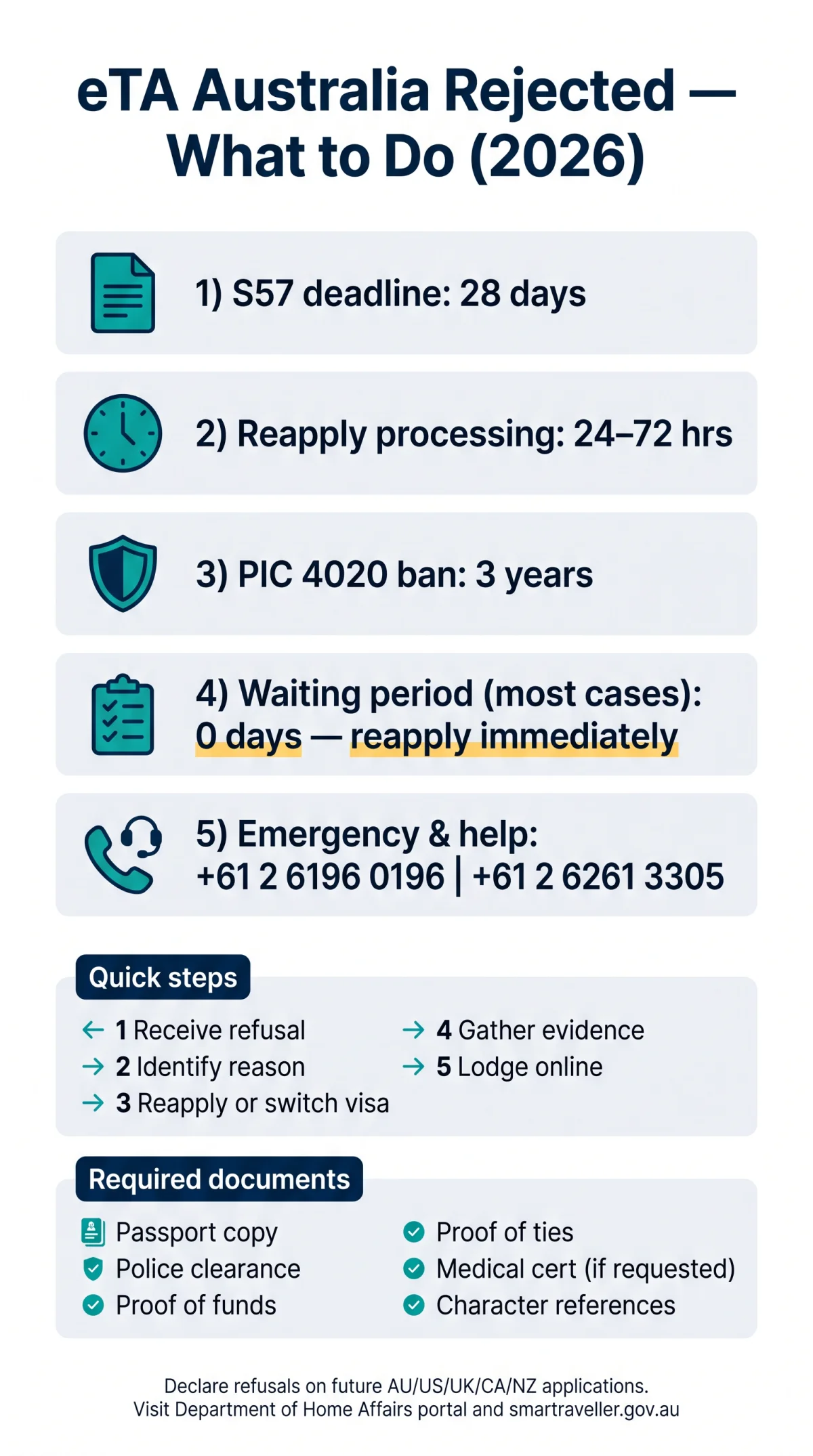
The Department of Home Affairs issues an S57 Natural Justice Letter detailing the reason for refusal, evidence considered, and your right to respond within 28 days.
Identify the specific reason
Distinguish between a final refusal and a referral to an Australian embassy for further assessment.
Decide between appealing and reapplying
You can reapply immediately for most refusal types; otherwise, switch to a different visa subclass.
Gather supporting evidence
Prepare police clearance, financial evidence, and proof of ties to your home country.
Lodge a new application
Submit via the Department of Home Affairs portal.
Track status
Check online or contact the Global Service Centre at +61 2 6196 0196. For consular emergencies, the Consular Emergency Centre operates 24/7 at +61 2 6261 3305. Travel advice is available at smartraveller.gov.au.
| Path | Action | Estimated Timeline |
|---|---|---|
| Appeal | Lodge appeal if eligible | Within 28 days of refusal |
| Reapply | Submit corrected eTA application | 24-72 hours processing |
| Switch visa | Apply for Subclass 600 | Days to weeks |
How to Reapply After an eTA Rejection
You can reapply immediately after most refusals if you correct the denial reason and include supporting documents.

| Refusal Type | Waiting Period | Recommended Action |
|---|---|---|
| General refusal | None, reapply immediately | Lodge a new application with corrected details |
| PIC 4020 false documentation | 3-year ban | Apply for a waiver or wait until the ban expires |
| Character-based refusal | Case-by-case | Obtain police clearance and character references before reapplying |
Before You Reapply
- Verify passport details
- Disclose all criminal history
- Confirm eligible nationality
- Prepare proof of funds and ties to home country
- State no working intentions
The application fee, payable via the Department of Home Affairs portal, is non-refundable even if refused again. Processing time for a new eTA is typically 24 to 72 hours.
Before reapplying, fix the 6 most common refusal triggers: incorrect passport details, undisclosed criminal history, declared work intentions, insufficient funds, false information, and an unanswered S57 letter. Each trigger maps to a refusal ground listed in Section 501 or PIC 4020.
Alternative Visa Pathways After an eTA Refusal
After an eTA refusal, alternative pathways include Subclass 600, eVisitor (Subclass 651), and Working Holiday (Subclass 417), depending on nationality and travel purpose.
| Visa Type | Eligibility | Processing Time | Cost |
|---|---|---|---|
| Visitor visa (Subclass 600) | All nationalities; allows comprehensive supporting evidence and written explanations | Varies by country | Check Department of Home Affairs for current fees |
| eVisitor (Subclass 651) | European passport holders only | Typically 24-72 hours | Free |
| Working Holiday visa (Subclass 417) | Age 18-30, up to 35 for select countries; work and travel purpose | Varies | Check Department of Home Affairs for current fees |
Choose Subclass 600 when the eTA Australia rejection process stems from a reason requiring detailed documentation, such as character concerns or financial evidence. Malaysian and US passport holders remain eTA-eligible; EU passport holders should apply for eVisitor (Subclass 651) instead. For streamlined processing, services like Tern (rated 4.7/5 by customers) offer fixed upfront pricing with a full refund if the visa application is refused.
eTA refusals are generally not merits-reviewable before the Administrative Review Tribunal (ART) because eTAs are discretionary decisions. Judicial review or a Subclass 600 application may be alternative pathways; consult an immigration lawyer for case-specific advice.
Appeal Options and Character Requirements for eTA Refusals
eTA refusals generally cannot be merits-reviewed by the Administrative Review Tribunal (ART) as they are discretionary decisions. Judicial review through the Federal Circuit and Family Court of Australia may be available for a refused ETA if a jurisdictional error or procedural fairness breach occurred. Any appeal application must be lodged within 28 days of the refusal decision.
Under Section 501 of the Migration Act (full text available at legislation.gov.au), a substantial criminal record, defined as a custodial sentence of 12 months or more, triggers mandatory visa refusal. The eTA Australia rejection process treats this as a character test failure, but a character waiver may offer a path forward.
To pursue a waiver: obtain a police clearance certificate from each country lived in for 12+ months in the last 10 years, gather character references from employers or community leaders, prepare a legal statement explaining rehabilitation, and submit all documentation with a new visa application. For complex cases, consult a registered migration agent such as Marcella Johan-mosi (MARN 1066619), who has over 10 years of experience specialising in complex character waivers through Open Visa Migration. Verify any agent’s MARN on the Office of the Migration Agents Registration Authority website.
Frequently Asked Questions (FAQ) about eTA Rejections
Can I reapply for an Australia tourist visa if my eTA gets rejected?
Yes, you can reapply for an eTA or apply for an alternative visa like the Visitor visa (Subclass 600). There is generally no statutory waiting period for most eTA refusals. You must address the reason for the original refusal before submitting a new application.
What happens if my eTA is denied?
You will receive a refusal notice, often an S57 Natural Justice Letter. The refusal is recorded on your immigration history and must be declared on future Australian and international visa applications. You can appeal if eligible or reapply with corrected information.
Why would my eTA be rejected?
Common reasons include criminal convictions, incorrect application data, previous visa overstay, false or misleading information, outstanding debts to the Australian Government, health grounds, and security concerns. Check the refusal notice for the specific reason.
How long does it take to reapply for an eTA after rejection?
No statutory waiting period applies to most eTA refusals. Lodge a new application as soon as the denial reason is corrected. Processing takes 24-72 hours. Exception: false documentation triggers a 3-year ban under PIC 4020.
Can I appeal an Australian eTA refusal?
eTA refusals are generally not merits-reviewable before the Administrative Review Tribunal (ART) because eTAs are discretionary decisions. You may seek judicial review or apply for an alternative visa subclass such as Subclass 600. Consult an immigration lawyer for case-specific advice.
Does an Australian eTA refusal affect other countries’ visa applications?
Yes, an eTA refusal is recorded on your immigration history and must be declared on future visa applications to Australia and other countries including the US, UK, Canada, and New Zealand. Failure to declare it may result in additional refusals due to shared intelligence databases.
Is there a waiting period before I can reapply for an eTA?
For most eTA refusals, there is no statutory waiting period. The main exception is a false documentation refusal under PIC 4020, which imposes a 3-year ban. Always correct the initial refusal reason before reapplying.
What is an S57 Natural Justice Letter and how do I respond to it?
A Section 57 Natural Justice Letter is a formal notice from the Department of Home Affairs explaining why your eTA may be refused. It allows you to respond with additional evidence or submissions. You must respond within the 28-day timeframe before a final decision is made.
Published: 2026 | Last reviewed: 31 August 2026. This article provides general guidance only and does not constitute legal or migration advice. Immigration outcomes are case-specific. For personalised advice, consult a registered migration agent (verify via the OMARA register) or a qualified immigration lawyer. Always verify current fees and processing times on the Department of Home Affairs website.