

Updated 31 August 2026. Policy details reflect Department of Home Affairs (DHA) updates as of August 2026; verify on the Home Affairs website before applying.
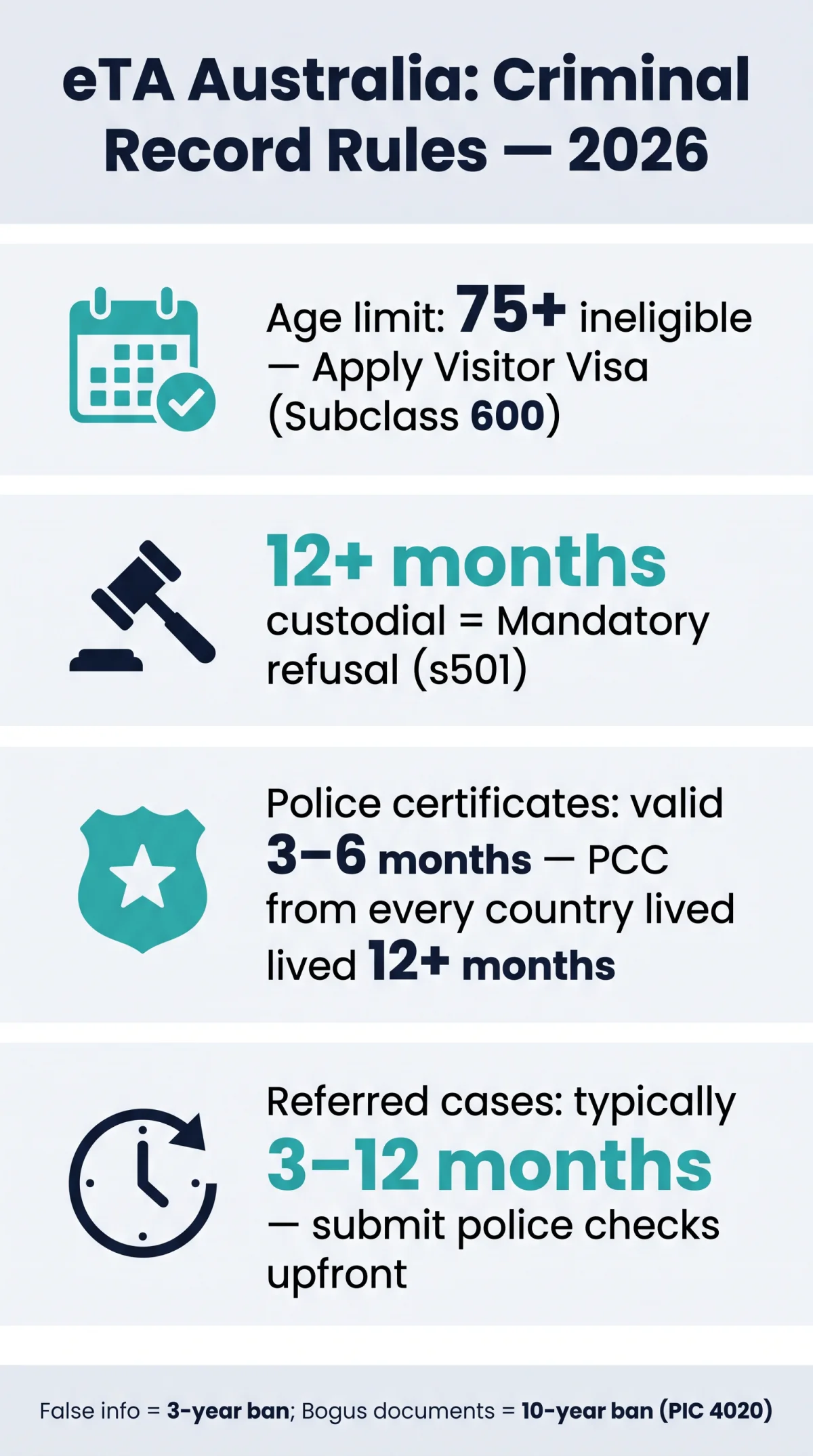
The eTA system has no character disclosure field, and the Department of Home Affairs (DHA) cross-references international police databases automatically. For eTA Australia criminal record purposes, any undisclosed conviction risks refusal or cancellation. Applicants aged 75 or over are categorically ineligible for an eTA regardless of criminal history.
Travellers with any conviction should apply for the full Visitor Visa (Subclass 600), which permits character disclosure and evidence submission. The eTA (Subclass 601) does not allow applicants to declare a criminal record, meaning DHA may refuse or cancel the eTA upon discovering undisclosed convictions through its database checks.
Under section 501 of the Migration Act 1958, a cumulative custodial sentence of 12 months or more constitutes a “substantial criminal record” and triggers mandatory visa refusal. All convictions must be disclosed regardless of whether they are spent or expunged in your home country.
What Is the Australian Character Test and How It Affects Your eTA Eligibility
Under section 501 of the Migration Act 1958 (see Home Affairs character requirements and Ministerial Direction 99), a cumulative custodial sentence of 12 months or more constitutes a “substantial criminal record” and triggers mandatory visa refusal. Under s501(6)(a) this triggers automatic refusal; under s501(6)(b) the Minister may refuse even without a 12-month sentence. This applies to all Subclass 601 applications and directly determines eTA Australia criminal record eligibility.
DHA distinguishes mandatory (s501(6)(a)) from discretionary refusal (s501(6)(b)). Offences commonly leading to disqualification include drug trafficking, violent crime, sexual offences, fraud, theft, domestic violence, and organised crime involvement. The eTA Australia criminal record check is automated: DHA flags applicants via international law-enforcement databases, and Subclass 601 has no character disclosure field.
Do Suspended Sentences and Community Orders Count?
Any sentence with a custodial component, even fully suspended, counts toward the 12-month threshold. Good behaviour bonds and community correction orders without a custodial element generally do not trigger the test.
Disclosure Requirements – What You Must Declare
All convictions must be disclosed regardless of jurisdiction, severity, or time elapsed. Full transparency is required; DHA cross-references foreign police databases.
Stage Two: Discretionary Character Assessment
For non-mandatory cases, the Minister exercises discretion under s501(6)(b) rather than issuing a formal waiver. Factors assessed include the nature of the offence, time elapsed since conviction, and rehabilitation evidence. The resulting character assessment record is retained in DHA systems.
Age Limit of 75 Years and eTA vs Visitor Visa (Subclass 600) Comparison
eTA Australia criminal record eligibility is categorically unavailable to applicants aged 75 or over, who must apply for the Visitor Visa (Subclass 600). This visa requires both a health exam (Bupa Medical Visa Services) and a character assessment; either can independently block the visa.
Decision flowchart:
75 or older?
eTA (Subclass 601) is unavailable
Apply for Subclass 600
Visitor Visa
Health + character assessment
Dual assessment required
Subclass 601 has no character disclosure field; any undisclosed conviction risks border cancellation. Subclass 600 permits full disclosure and evidence submission. Any conviction requires Subclass 600, regardless of age. The eTA Australia criminal record question is therefore moot for applicants over 75.
| Feature | eTA (Subclass 601) | Visitor Visa (Subclass 600) |
|---|---|---|
| Age limit | Under 75 only | No upper limit |
| Character disclosure | No field; none permitted | Full disclosure + evidence |
| Health exam | Not required | Required (Bupa) |
| Processing | Minutes to days | Weeks to months |
Police Checks, Clearance Certificates and Non-Disclosure Penalties
DHA requests a police clearance certificate (PCC) when an eTA Australia criminal record application is referred for character assessment. PCC is required for each country where you lived 12+ months in the past 10 years; validity is 3 to 6 months.

Which Police Certificates Does Australia Accept? – Country-by-Country Guide
| Country | Issuing Authority | Approximate Cost | Processing Time | Validity |
|---|---|---|---|---|
| Australia | AFP National Police Check | ~$42 AUD | Varies | 3 to 6 months |
| UK | ACRO | ~£45 | Varies | 3 to 6 months |
| US | FBI Identity History Summary | ~$18 USD | 12 to 14 weeks | 3 to 6 months |
| Canada | RCMP | ~CAD $60 to $80 | Varies | 3 to 6 months |
| Germany | Führungszeugnis | Free | 2 to 4 weeks | 3 to 6 months |
What Happens If You Don’t Disclose – Section 4020 Penalties
Public Interest Criterion 4020 (Schedule 4, Migration Regulations 1994) imposes a 3-year bar for false information and a 10-year bar for bogus documents. Omitting a 2019 shoplifting conviction triggers a 3-year ban. Australia does not recognise foreign spent convictions like the UK Rehabilitation of Offenders Act 1974 or US state expungement laws. The eTA Australia criminal record disclosure obligation applies regardless of conviction age or jurisdiction.
Consequences of Failing the Character Test and How to Strengthen Your Application
A section 501 visa refusal creates a permanent character assessment record in Department of Home Affairs (DHA) systems and adversely affects all future Australian visa applications. Complex eTA Australia criminal record cases are referred to the Visa Application Character Consideration Unit (VACCU).
Border Refusal – Can You Be Turned Away at the Airport?
An approved eTA does not guarantee entry. DHA officers can cancel an eTA at the airport upon discovering an undisclosed record: secondary screening, interview, cancellation, detention, removal. Re-entry bans may apply; eTA Australia criminal record eligibility becomes harder to establish in future applications.
How Long Does a Character Assessment Take?
DHA does not publish fixed timelines. Referred cases typically take 3 to 12 months or longer. Minimise delays by submitting all police checks upfront and responding promptly to s56 requests.
Character Evidence Checklist
DHA may request Form 80 and Form 1221, requiring 10+ years of personal, travel, and employment history. For eTA Australia criminal record mitigation, prepare:
Character reference letters
2-3 on letterhead from employers or community leaders
Rehabilitation evidence
Employment records, certificates, community service logs
Personal statement
What happened, accountability, what changed, why Australia, ties to home country
Court documents
Sentencing remarks, proof of sentence completion, fine payment evidence
This article is published by an independent travel information portal and does not constitute legal advice. For individual cases, consult a registered migration agent.
FAQ
Does a criminal record automatically disqualify me from getting an eTA for Australia?
Any conviction can cause eTA Australia criminal record refusal because the system lacks a disclosure field. DHA automatically cross-references international police databases; undisclosed records trigger refusal or cancellation. Applicants with any conviction should apply for the full Visitor Visa (Subclass 600) instead, where they can disclose their history and submit supporting evidence.
What types of crimes make me ineligible for an Australian eTA?
Offences commonly leading to refusal include drug trafficking, violent crime, sexual offences, fraud, theft, domestic violence, and organised crime involvement. A cumulative custodial sentence of 12 months or more triggers mandatory refusal under section 501(6)(a) of the Migration Act 1958. All eTA Australia criminal record convictions are assessed under the character test.
Does Australia recognise spent convictions from the UK or expunged records from the US?
No. Australia requires disclosure of all convictions regardless of whether they are spent under the UK Rehabilitation of Offenders Act 1974 or expunged under US state laws. Failure to disclose may trigger a 3-year ban under Public Interest Criterion 4020.
How long after a conviction can I apply for an eTA to Australia?
There is no fixed waiting period. The longer the time elapsed and the more rehabilitation evidence you demonstrate, the stronger your case. For mandatory refusals (12+ months custodial), there is no time-based exemption; you must apply for Subclass 600 and undergo character assessment.
Can I appeal an Australian eTA refusal based on criminal history?
eTA decisions are largely automated with no formal appeal process. Options include applying for a Visitor Visa (Subclass 600) with full character disclosure, requesting ministerial intervention under section 351 or 417 of the Migration Act, or reapplying after addressing the character concern. Consult a registered migration agent for complex cases.
I’m over 75. Can I still visit Australia if I have a criminal record?
The eTA Australia criminal record assessment does not apply to applicants over 75; they cannot use the eTA at all. You must apply for the Visitor Visa (Subclass 600), which requires a health examination and character assessment. Applicants over 75 with a conviction face a dual assessment where either requirement can independently cause refusal.
What police clearance certificate do I need for an Australian visa application?
DHA may request a police clearance certificate from every country where you lived 12+ months in the past 10 years. The certificate must be from the relevant national police authority (AFP in Australia, ACRO in the UK, FBI in the US). Certificates are typically valid 3 to 6 months; apply close to the time DHA requests one.
Can I be refused entry at the Australian border even with an approved eTA?
Yes. An approved eTA does not guarantee entry. DHA officers at Australian airports can cancel an eTA upon discovering an undisclosed criminal record. The process involves secondary screening, interview, cancellation, potential detention, and a removal flight. Re-entry bans may apply, and future visa applications become significantly harder.
What happens if I forget to disclose a conviction on my Australian visa application?
Providing false or misleading information triggers a mandatory 3-year ban under Public Interest Criterion 4020 of the Migration Regulations 1994. Bogus documents trigger a 10-year ban. DHA checks foreign police databases and intelligence-sharing agreements, so undisclosed records will surface.
How long does a character assessment take for a visa application referred to VACCU?
DHA does not publish fixed timelines. Character assessments typically take 3 to 12 months or longer for complex cases. Submit all police checks upfront and respond promptly to s56 requests to minimise delays.