

An eTA Australia overstay of more than 28 days triggers a 3-year re-entry ban, detention, removal costs up to AUD $15,000, and impacts future Five Eyes visa applications.
In 2026, the Department of Home Affairs strictly enforces visa conditions under the Migration Act 1958. An eTA Australia overstay immediately voids your electronic travel authority, while breaches like working under Condition 8101 or studying past the 3-month limit under Condition 8201 lead to immediate visa cancellation under Section 116. You will accumulate unlawful presence days, face the Section 48 bar preventing onshore substantive visa applications, and your overstay record will be shared with the US, UK, Canada, and New Zealand.
If you realize your eTA has expired, you must not work or study. Contacting the Status Resolution Service (SRS) is a safe first step to arrange voluntary departure and apply for a Bridging Visa E (Subclass 050 or 051). Leaving voluntarily rather than facing deportation may be viewed more favorably in future visa applications, though the 3-year ban still applies for overstay periods exceeding 28 days.
Last updated: 31 August 2026. This article is general information published by an independent tourist information portal, not legal advice. Always confirm current rules with the Department of Home Affairs (immi.homeaffairs.gov.au) or a registered migration agent.
What Is an eTA and When Does Overstay Begin?
An eTA (Subclass 601) grants 3-month stays per entry over 12 months; an eTA Australia overstay triggers unlawful status at 00:01 after expiry, with no grace period.
An eTA Australia overstay begins as soon as your permitted stay ends. The eTA (Subclass 601) is valid for 12 months, allows multiple entries, and caps each stay at 3 months (90 days). The eTA expiry and stay expiry are distinct: your authority may remain valid while your stay has ended.
Unlawful non-citizen status starts at 00:01 on the day after expiry. The 28-day threshold under Section 140H of the Migration Act 1958 determines ban length, not the onset of unlawful status. An eTA Australia overstay of fewer than 28 days may qualify for a ban waiver; exceeding 28 days triggers an automatic 3-year re-entry ban.
In 2015-16, 10,944 people were removed after overstaying or visa cancellation, per aph.gov.au.
Working Illegally on an eTA – Condition 8101 Explained
Condition 8101 prohibits all paid work on an eTA; any breach triggers immediate visa cancellation under Section 116 and a 3-year re-entry ban.
An eTA Australia overstay often starts with illegal work, as tourists extend their stay to keep earning beyond the 3-month limit. Common violations include:
- Farm work: picking fruit or vegetables for cash or accommodation while on an eTA.
- Hostel housekeeping: cleaning rooms or reception work in exchange for lodging.
- Barista trial shifts: unpaid trial days that still qualify as work under Australian law.
Freelance online work, unpaid internships, and cash-in-hand jobs breach Condition 8101 just the same. An eTA Australia overstay combined with illegal work voids the eTA (Subclass 601) immediately under Section 116 of the Migration Act 1958. Contact the Status Resolution Service (SRS) before departure to arrange assisted voluntary removal.
Studying on an eTA: The 3-Month Limit (Condition 8201)
Condition 8201 caps eTA study at 3 months; exceeding it triggers cancellation under Section 116. An eTA Australia overstay often begins when a tourist enrolls in a 6-month English course.
| Feature | eTA (Subclass 601) | Student Visa (Subclass 500) |
|---|---|---|
| Max study duration | 3 months | Full course length |
| Genuine Student (GS) test | Not required | Required |
| Confirmation of Enrolment (CoE) | Not required | Required |
| Financial evidence | Not required | Required |
| Work rights | Prohibited (Condition 8101) | Permitted |
If your course exceeds 3 months, apply for a Student Visa (Subclass 500) before arrival. An eTA Australia overstay caused by exceeding the study limit voids the eTA immediately under Section 116.
Visa Cancellation, Re-Entry Ban, and eTA vs Visitor Visa Differences
Border officers can cancel an eTA under Section 116; an eTA Australia overstay beyond 28 days triggers a 3-year re-entry ban under Section 140H.
An eTA Australia overstay voids the eTA upon detection of any condition breach. Port-of-entry cancellation occurs when officers suspect work intention, insufficient funds, inconsistent travel history, or previous overstays. A Notice of Intention to Consider Cancellation (NOICC), preceded by an S57 Natural Justice Letter outlining the alleged breach, is rarely issued to eTA holders in-country. Providing false information on the eTA application activates PIC 4020, imposing a 10-year exclusion period.
The 3-year ban applies regardless of voluntary or involuntary departure; overstays under 28 days may receive a discretionary waiver but remain unlawful.
| Feature | eTA (Subclass 601) | Visitor Visa (Subclass 600) |
|---|---|---|
| Max stay per entry | 3 months | 3, 6, or 12 months |
| Onshore extension | No (Section 48 bar) | Yes, in certain circumstances |
| Cancellation | Often at port of entry (Section 116) | NOICC may be issued |
Detention, Removal Costs, and New Visa Restrictions After Overstay
Involuntary removal creates a recoverable Commonwealth debt averaging AUD $8,000-$15,000 under Section 262; the Section 48 bar blocks most onshore visa applications after eTA cancellation.
- An eTA Australia overstay can lead to detention at facilities such as Melbourne Immigration Transit Accommodation or Yongah Hill Immigration Detention Centre.
- Voluntary departure means leaving on your own and may be viewed more favourably in future applications; involuntary removal is arranged by the Department of Home Affairs.
- Under Section 262, removal costs become a recoverable Commonwealth debt (~AUD $8,000-$15,000) that must be repaid before any future visa grant.
- The Section 48 bar prevents most onshore substantive visa applications, with narrow exceptions like protection visas (Subclass 866).
- A Bridging Visa E (Subclass 050/051) is available for up to 28 days, grants no work rights, and serves only to organise departure.
- An eTA Australia overstay creates a permanent immigration record assessed under the character test (Section 501) and GTE criteria, with data shared across Five Eyes countries (US, UK, Canada, NZ).
- Ministerial intervention (Section 351/417) exists but is extremely rare for eTA holders.
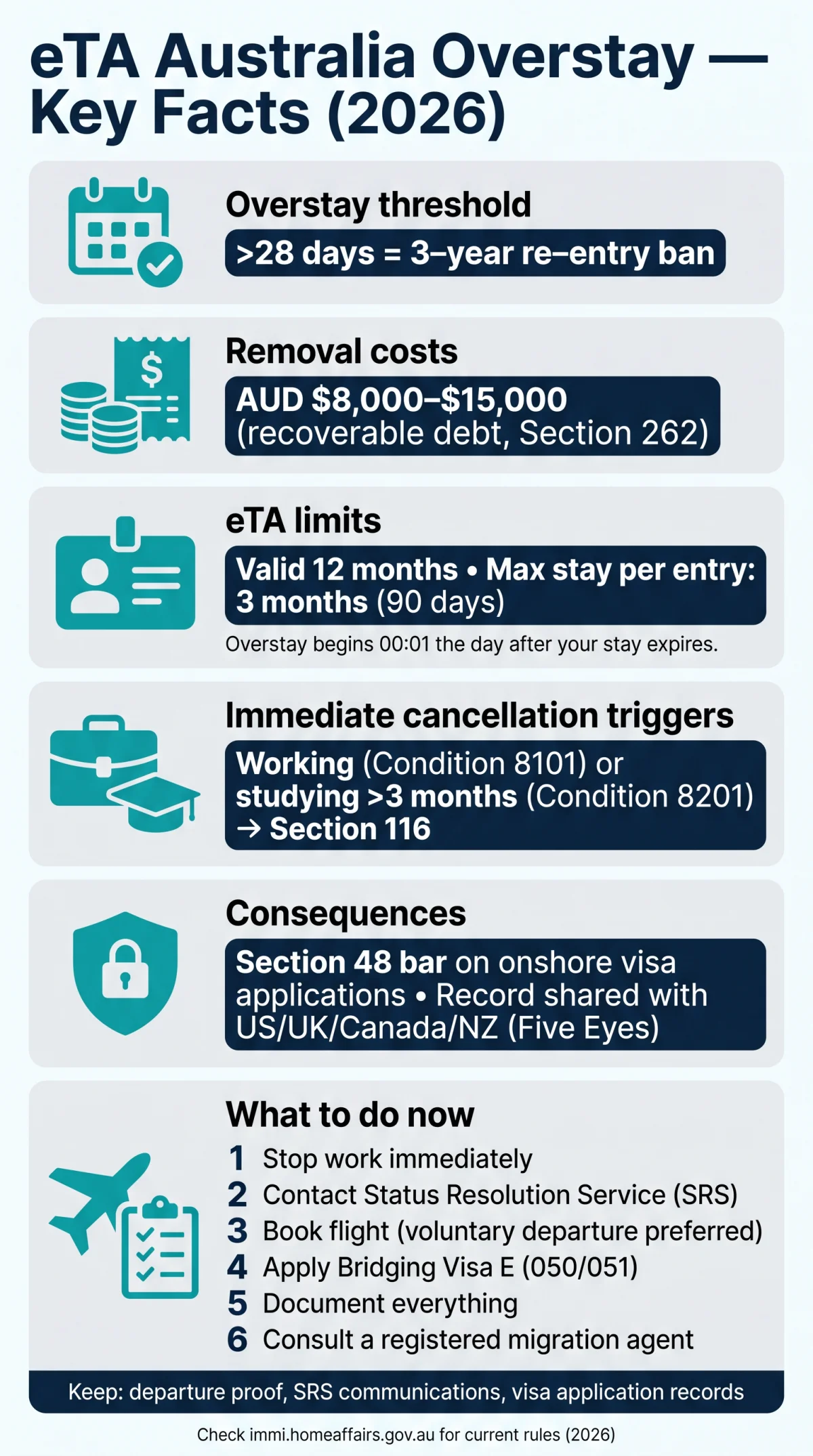
What to Do Immediately If You’ve Overstayed Your eTA
Contact the Status Resolution Service (SRS) immediately. This government service helps overstayers arrange voluntary departure without arrest.

An eTA Australia overstay requires swift action to minimise penalties. Follow these steps:
Stop working immediately
Any paid work while unlawfully present worsens your situation and triggers visa cancellation under Section 116.
Contact the Status Resolution Service (SRS)
Calling SRS does not lead to arrest; it is the safest first contact for an eTA Australia overstay.
Book a flight as soon as possible
Voluntary departure is viewed more favorably than involuntary removal in future visa applications.
Apply for a Bridging Visa E (Subclass 050/051)
If you need up to 28 days to organise departure. This visa does not allow work.
Document everything
Keep records of your departure date, SRS communications, and any visa applications.
Consult a registered migration agent
If your circumstances are complex (e.g., health issues or family ties in Australia).
FAQ: eTA Australia Overstay Consequences
What are the penalties for overstaying an eTA in Australia?
An eTA overstay under 28 days makes you an unlawful non-citizen but may allow a ban waiver. Over 28 days triggers a 3-year re-entry ban, detention, and removal costs averaging AUD $8,000 to $15,000.
Can I work illegally on an eTA in Australia?
No. Condition 8101 prohibits all paid work on an eTA (Subclass 601), including unpaid internships and cash-in-hand jobs. Breaches trigger cancellation under Section 116, a 3-year re-entry ban, and potential detention.
Can I study on an eTA in Australia?
Yes, for a maximum of 3 months under Condition 8201. Exceeding it triggers cancellation under Section 116. For longer study, apply for a Student Visa (Subclass 500).
What is the re-entry ban for overstaying an eTA?
An eTA Australia overstay exceeding 28 days triggers an automatic 3-year re-entry ban under Section 140H. Under 28 days may receive a discretionary waiver.
How do I apply for a Bridging Visa E after overstaying my eTA?
Contact the Status Resolution Service to apply for a Bridging Visa E (Subclass 050/051). It lasts up to 28 days, does not allow work, and is only for organising departure.
What happens if my eTA is cancelled for overstaying?
Your eTA Australia overstay leads to cancellation under Section 116, unlawful non-citizen status, the Section 48 bar, and a 3-year re-entry ban if overstay exceeds 28 days.
What is the difference between voluntary departure and deportation for eTA overstay?
Voluntary departure means leaving on your own, viewed more favorably in future applications. Involuntary removal incurs a Commonwealth debt under Section 262. Both trigger a 3-year ban if overstay exceeds 28 days.
Will overstaying my eTA affect future visa applications to Australia?
Yes. An eTA Australia overstay is permanently recorded, impacts the character test (Section 501) and GTE assessment, and is shared with the US, UK, Canada, and NZ via Five Eyes.
Can I get a waiver for the eTA overstay penalty?
The Department may waive the ban for overstays under 28 days. For over 28 days, a waiver is extremely rare. Ministerial intervention (Section 351/417) is rarely granted to eTA holders.
What is the Status Resolution Service and should I contact them?
The Status Resolution Service (SRS) is a safe contact point for unlawful non-citizens. They help arrange voluntary departure and provide information on applying for a Bridging Visa E.